All eyes of sport – and more – are on 5G
When it comes to sports coverage products, one of the recurring topics today is live video broadcasting over 5G networks.
Indeed, live broadcasting on 3G networks has long since revolutionized the way media work.
5G is taking this technology to a new level, with the world of sports evidently showing a keen interest in these developments.
AVIWEST, a French company distributed in Italy by CVE Communication Video Engineering, is shaping the future of live video.
AVIWEST equipments have undergone long field tests that have allowed hypotheses to be verified and future use cases to be demonstrated.
 It is no coincidence that they have already been adopted for Beijing Winter Games 2022 (4-20 February).
The use of the carrier-side test infrastructure from the field, built by AVIWEST in collaboration with Orange since 2008, has been very useful, as the proximity to the AVIWEST research and development laboratories has allowed to benefit from the intertwined insights that the experts of both companies have on 5G.
Mauro Contursi General Manager of CVE states:
“We will soon be able to count on an even greater diffusion of these networks and the partnership with AVIWEST will allow CVE to be even more responsive to customer requests and even more competitive than other traditional forms of contribution.
 It is evident that since 2008 the technological leaps have been revolutionary and from 3G to the current 5G networks the disruption in live connections for the media, and especially in live sports, has risen to a new level.
For a long time, streaming live content required complicated infrastructure.
To film and broadcast a report live from a foreign country, journalists and TV crews were needed, as well as a production team and a van equipped with a satellite dish.
Today AVIWEST solutions are a game changer enabling reliable remote live production with 4K and UHD multi-camera systems.
An example is the new AVIWEST PRO460-5G cellular transmitter, based on Safe Stream Transport technology and its StreamHub receiver implemented in Multi-Access Edge Computing (MEC).
Here, artificial intelligence resources are crucial for optimizing video transcoding in the cloud. This provides viewers with the best video quality and lowest latency, ensuring high QoE (the quality of the viewing experience), among other things, with a lower carbon footprint.”
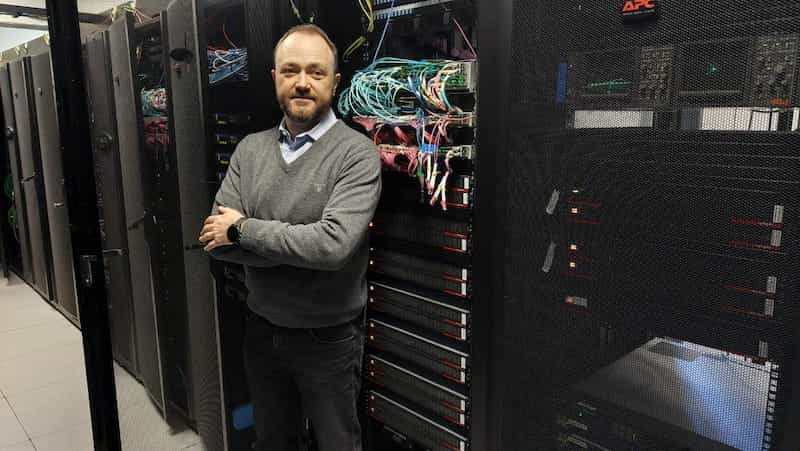 Luca Mancini, CTO of CVE underlines some merits:
“AVIWEST’s solutions integrate the latest digital coding algorithms.
From the very beginning, video compression was a crucial challenge to be able to stream video at 3G speeds without reducing quality.
In addition, cellular networks were equipped with variable speeds, but with no guarantee of bandwidth.
This is especially true for places with high turnout, such as concerts, sports matches, etc.
For professionals, it was imperative to have robust transmissions, regardless of the environment or the number of users on the network.
 5G already allows all camera feeds to be sent directly and almost instantly to the broadcast control room, even thousands of kilometers away.
This concept makes remote production an entirely viable procedure, as amply demonstrated during the pandemic.
The entire production team does not necessarily have to be on site at the event”.
Live Remote Production by AVIWEST
AVIWEST’s 5G Live Remote Production solution is based on better network availability, lower latency and higher gigabit speeds.
The latency promised by 5G networks will be in the millisecond range and slicing will provide professionals with dedicated bandwidth, even in a full stadium.
 Athletes, racing cars, motorcycles, bicycles, skiers, and myriad other actors in sports can be equipped with 5G cameras to stream exceptionally immersive live video.
The obvious advantages are in the increase in operational efficiency and cost savings, but also in the possibility of adapting the quality of production to the scope of the event and investing in the production of more content, for example even in sports considered “minor”.
Benefits and Challenges of Remote Live Sports Production
The workflow in the tv production of live sports is drastically simplified compared to that in an on-site studio or a broadcast van outside the venue.
In addition to reducing the number of people needed on-site and thereby reducing logistical costs and complexity, it also helps produce more content for level 2 and level 3 sports and improves live production of level 1 sports, utilizing multiple cameras within the venue where the sporting event takes place.
Indeed, more and more cameras are now based on IP technology, including PoV and PTZ or embedded cameras connected to 5G transmitters.
With these new production configurations, broadcasters can provide better coverage from multiple angles.
 These camera setups are easy to remotely control and give spectators an immersive view of the competition venue, covering every corner of the pitch.
Given the miniaturization, small cameras and transmitters are often used in confined spaces, such as the inside of a racing car or racing boat, a helicopter or even worn, allowing viewers to get closer to the action than ever before.
Connectivity in remote production is crucial and where 99% of these productions are based on IP technology, the network must be stable, otherwise the remote control will be lost.
By using reliable broadcast technology, broadcasters can ensure a strong connection between the field and the studio.
Furthermore, the low latency of 5G between the venue and the studio ceases to be an issue during a live remote production in the cut between the various cameras.
Some AVIWEST proposals
AVIWEST offers various solutions for the 5G universe.
At the head of these, the Air320e-5G series and the new the new Pro460.
 Air320 5G
The Air320 5G series, ultra portable mobile transmitter on HEVC and H.264, allows to send premium quality live video over IP networks: 3G / 4G / 5G, Ethernet, Wi-Fi and satellite networks such as BGAN, GX and Ka Band.
It allows to record the live signal automatically and progressively simultaneously on an SD card with different resolutions and bitrates to ensure the best video quality.
On board it ensures Safe Streams Technology (SST), preview video, IFB / Intercom, Video Return, Data Bridge, Auto Live start, AES scrambling, geolocation, and operates with HD video: 1080p25 / 29.97 / 30/50 / 59.94 / 60, 1080i50 / 59.94 / 60, 720p50 / 59.94 / 60, SD: PAL, NTSC.
The expected encodings are: H.265 / HEVC 4: 2: 0, 8-bit, H.264 / AVC 4: 2: 0, 8-bit, with dynamic resolution adjustments.
The guaranteed bitrates are: from 200 Kbps to 20 Mbps Constant Bitrate (CBR), Variable Bitrate (VBR).
 The Pro460 model
It is a cellular transmitter designed for remote and home video production over 5G networks.
Born for remote production for live events: sports, entertainment, concerts and interactive TV shows, it comes in a compact form factor suitable for backpack mounting or V mount / G mount camcorders.
It supports 4K UHD and multi-camera workflows for up to four fully synchronized high-resolution feeds.
A “Mobility enhancer” the PRO460 delivers premium quality and huge savings in capital and operational expenses, to cover multiple events with simplified logistics and minimal staffing requirements on site.
It supports frame-accurate wireless synchronization and video transmission of multiple cameras.
This ensures seamless multi-camera switching in the studio.
It features high definition video return (up to 1080p50 / 60) for reliable monitoring or teleprompting.
It supports the latest generation of H.265 / HEVC and H.264 / AVC compression standards to fit new and existing infrastructures.
###
© 2022 CVE Communication Video Engineering – robertolandini Presspool
INFO: CVE-italy.com